Food Ingredient Checker Guide: 4 Leading Apps Reviewed
Compare leading food ingredient checker tools to make more informed choices. Explore how they assess product safety to find a platform aligned with your needs.
Sign up for Olive Written by Alexander KleinPublished on October 1, 2026
The food aisle is loaded with food products promising “non-toxic” or “natural” ingredients. Still, brands with such bold claims may offer products that, instead of fueling you, contribute to those midday crashes, brain fog, and mood fluctuations.
Food ingredient checkers help you see past marketing ploys, understand what you and your family eat, and recognize toxin-free alternatives hidden among flashy labels. However, not every checker can help you build a cart you trust, as their evaluation methods, capabilities, and key features vary widely.
This guide presents the most important considerations when choosing a food ingredient checker and reviews four popular options to help you select one that works for you.
- What an ingredient scanner for food should ideally offer
- What features and potential limitations top food ingredient checkers have
- How to find the option aligned with your priorities
Know what's really in your cart.
Sign up for OliveWhat Should You Look For in an Ingredient Scanner for Food?
A food ingredient checker can significantly cut the research time and help you shop with greater confidence. Instead of reviewing each component manually, you scan a product’s barcode, locate it in a product directory, or paste the ingredient list and identify ingredients that could potentially be harmful to your health.
But with so many options available, it can be difficult to determine the best solution for your individual needs. The following table outlines key considerations while evaluating ingredient scanners for food:
| Key Consideration | Why It Matters |
|---|---|
| Scanning capabilities | The ability to scan a product’s barcode without manually entering its ingredient list can make the process quicker and more convenient |
| Search bar | If you don’t have the product in front of you but want to learn more about its ingredients, finding it through a search bar is a convenient addition |
| Product database | Platforms offering broader product directories allow you to check for a wider selection of items |
| Methodology | Whether the platform bases its analysis on publicly available information, scientific studies, proprietary research, or expert collaboration can make or break the reliability of the scores |
| Independence vs. bias | If a platform accepts paid contributions, advertisements, and brand deals, the scores and cleaner-swap recommendations could be influenced by external factors |
| Product scope | Apps that analyze multiple product categories within your household can provide more comprehensive, whole-home guidance |
A Closer Look at 4 Popular Ingredient Checkers for Food
The right choice of a food ingredient checker depends on your personal goals, preferred scoring methodology, and the platform format you find most efficient. To help you make a confident decision, we’ve evaluated four of the best ingredient checkers for food:
- Olive
- Yuka
- Bobby Approved
- Open Food Facts
Scan Any Grocery Barcode
Scores Brands Can't Buy
Backed by Lab Testing
Cleaner Swaps in the Aisle
1. Olive
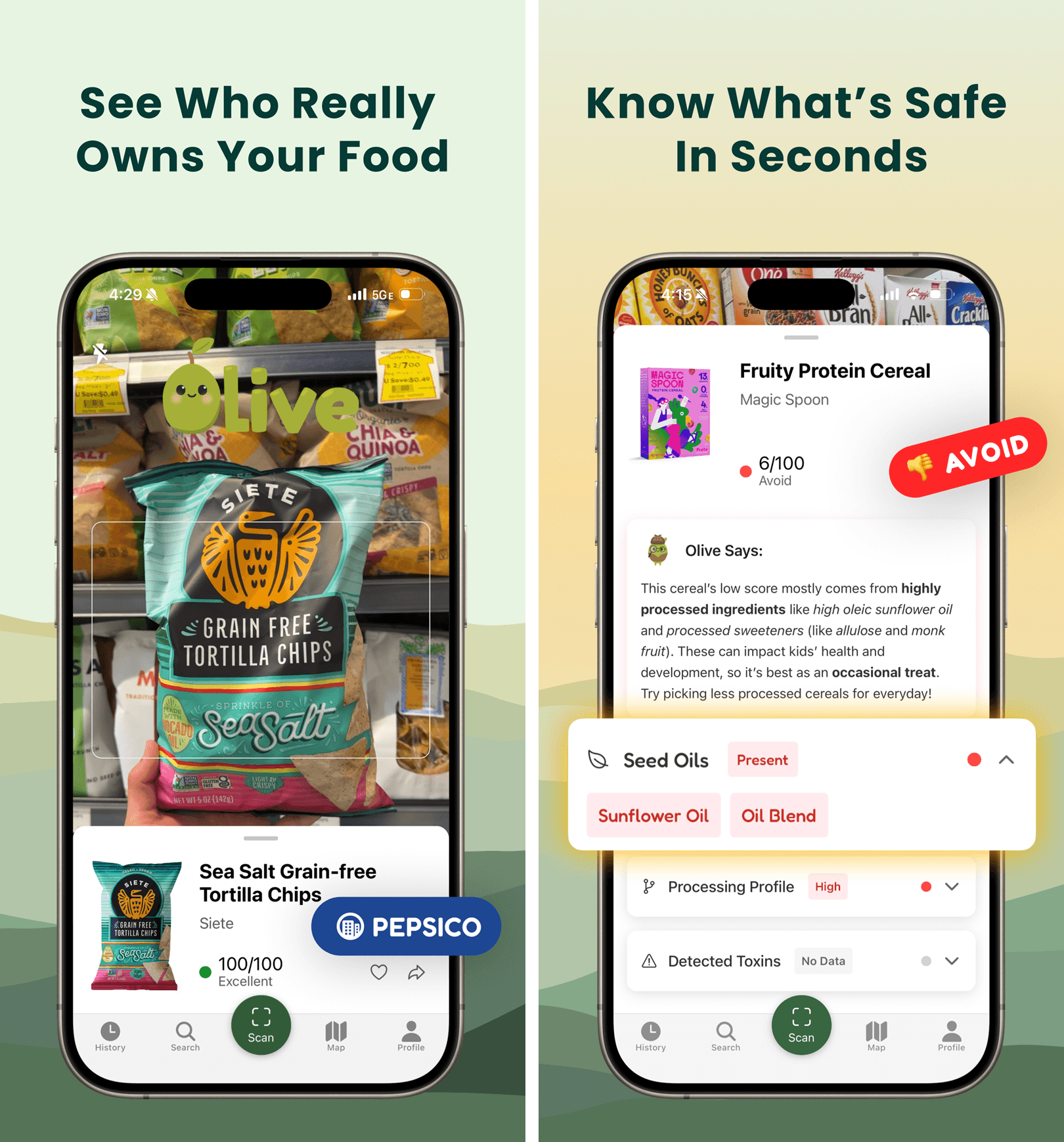
Olive is a holistic health companion that combines food scanning with checks of cosmetics, personal care, household products, and bottled water, identifying potentially harmful ingredients and automatically suggesting healthier swaps within the same category.
It doesn’t blindly trust the label claims and listed ingredients. Instead, Olive independently tests products to detect any concealed contaminants, including heavy metals such as cadmium, lead, arsenic, and mercury. The scope of Olive’s tested-product database surpasses even that of large organizations such as Consumer Reports.
Here’s how you can check food products using Olive:
- Scan a product’s barcode or find it manually using the search bar
- Access an Olive health score ranging from 0 for the worst items to 100 for the best picks
- Review flagged ingredients and straightforward explanations of potential health concerns
- For poorly rated products, explore better-quality alternatives within the same category
Your Olive journey toward cleaner food choices starts with the 28-Day Kitchen Detox challenge. It helps you clean up your pantry, buy cleaner substitutes, and lay the foundation for healthier habits.
You can try Olive free on iOS and Android.
2. Yuka
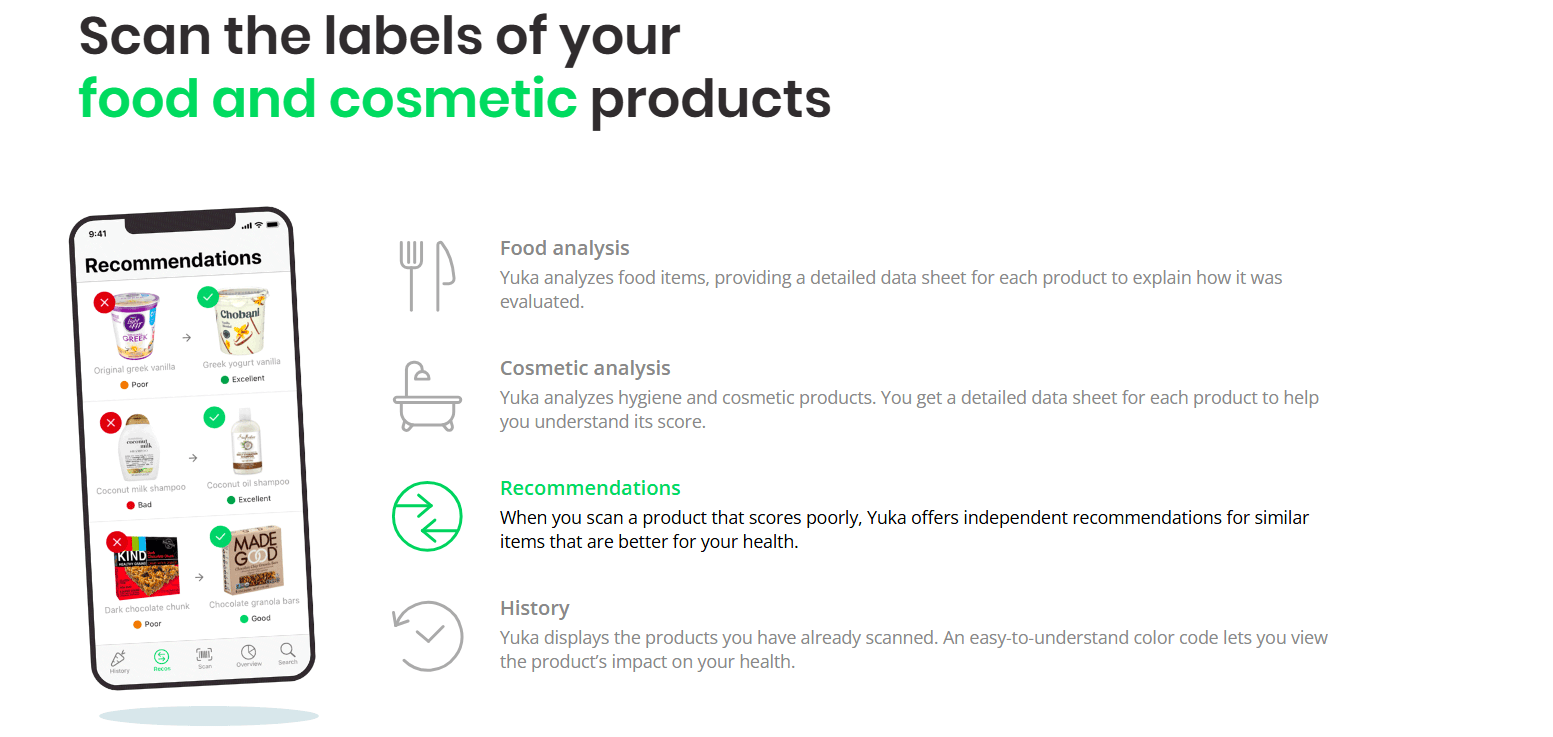
Yuka is a food and cosmetic scanning app that helps you decipher ingredient lists. It claims to base its food analysis on a broad database of more than 4 million products, with new items added daily.
While the free version supports core scanning functionality, the paid tier lets you set personalized dietary preferences, manually search for products, and use the app offline. Yuka presents itself as a completely independent project funded by paid subscriptions, not brand endorsements or paid advertisements.
Its food-scoring method is threefold, with each factor accounting for a different portion of the overall score. Here’s a Yuka app ingredient breakdown example:
- 60% of the score comes from nutritional quality based on Nutri-Score, an internationally recognized labeling system that evaluates the nutritional balance of food products
- 30% of the score is attributed to the presence of additives, based on recommendations from EFSA and the IARC, as well as independent studies
- 10% of the score depends on the existence of an official national or international organic label
While Yuka bases its analysis on guidance from established organizations and scientific studies, it doesn’t conduct independent product testing. That is a limitation compared to platforms that combine proprietary standards with independent laboratory analysis.
See how Yuka compares to other popular barcode scanners:
3. Bobby Approved
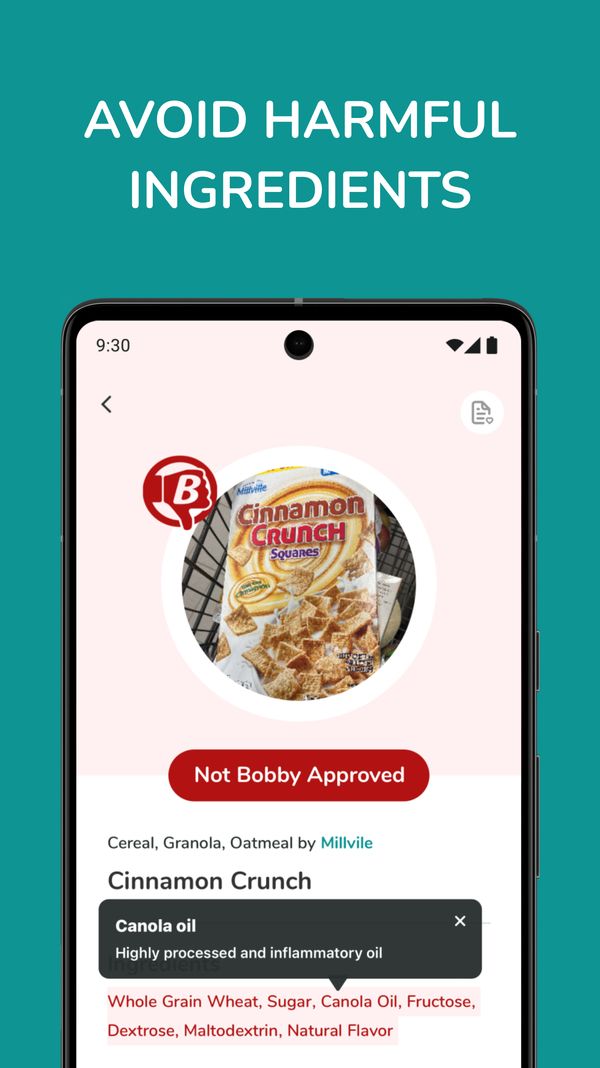
Developed by social media influencer and FlavCity founder Bobby Parrish, Bobby Approved is a free food scanner that focuses solely on food products. It was designed to translate Bobby’s grocery-shopping guidance into an automated app that lets you scan a barcode and receive a simple “approved” or “not approved” result.
Bobby Approved grounds its analysis on the founder’s personal research and a database of 100+ potentially harmful ingredients, translated into ten key principles according to which products are evaluated:
- No seed oils
- No artificial or refined sugars
- No harmful preservatives
- No GMOs
- No artificial or falsely advertised “natural” flavors
- No harmful pesticides or chemicals
- No artificial food colorings
- No heavily processed ingredients
- No harmful toxins
- No harmful fragrances
To check a food item, point your phone’s camera at the barcode and view the analysis summary. Ingredients associated with potential health concerns are highlighted in red, and tapping on them reveals an explanation of the rating.
You can browse the product directory manually, with products grouped by stores. If an item isn’t Bobby Approved, the app offers alternatives it considers healthier based on its criteria.
The cleaner swaps, however, may prioritize FlavCity products, raising questions about the objectivity of the recommendations. Furthermore, Bobby Parrish has no known formal credentials in nutrition or dietetics, and the platform doesn’t disclose the scientific studies supporting its ingredient classifications.
4. Open Food Facts
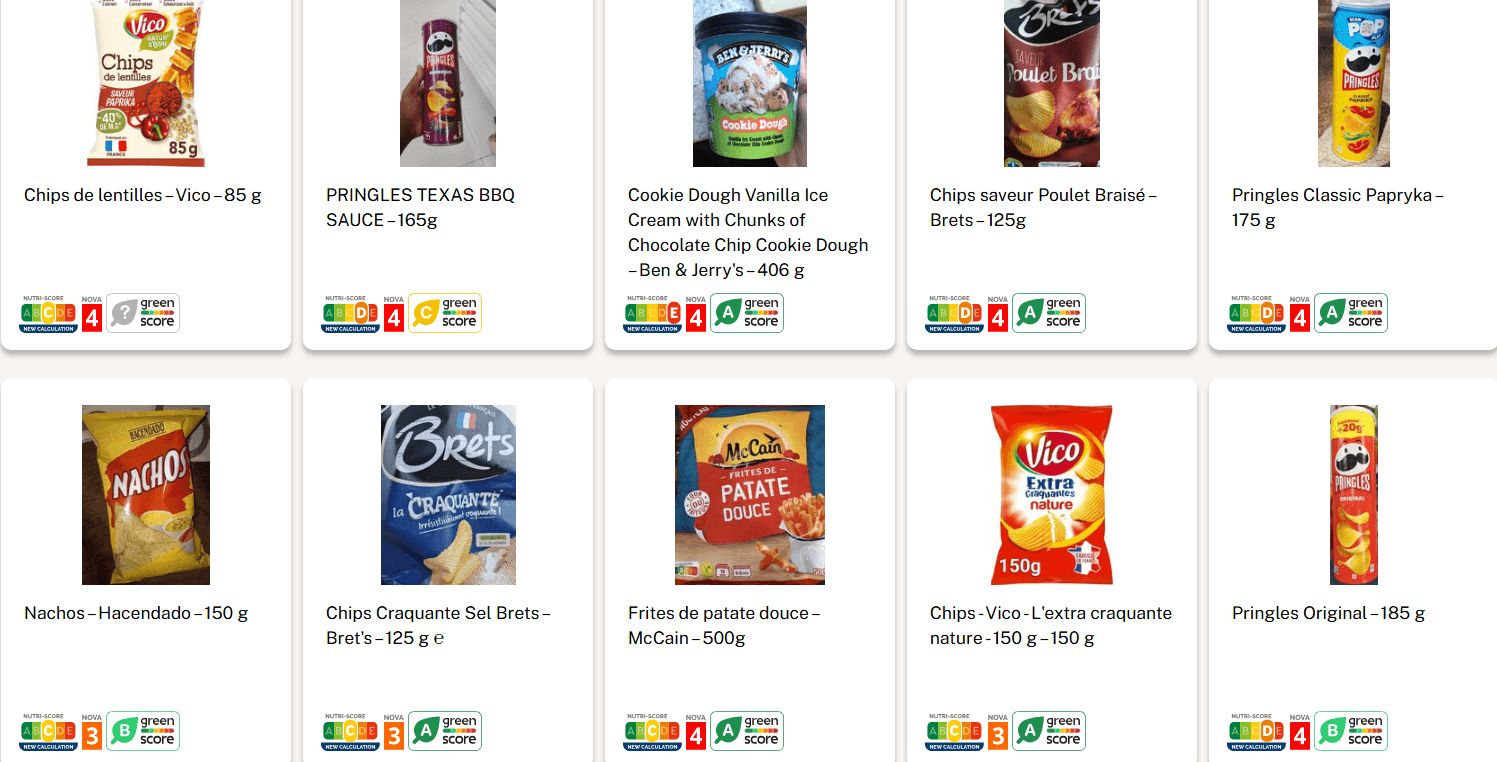
Open Food Facts is a food ingredient-checking website built around an open-data product database. It’s available to everyone, not only to use but to make contributions, making it a collaborative, community-based platform. In addition to the website, Open Food Facts offers iOS and iPhone apps through which users can scan products and submit new information.
This nonprofit project is largely supported by individual donations. Its database counts more than four million products from approximately 150 countries, built by over 100,000 contributors. The ingredient checker allows you to:
- Understand product labels by deciphering ingredients, additives, allergens, and traceability codes
- View grades for nutritional quality and level of processing
- Manually search for products based on specific criteria, including the presence of additives, palm oil, and specific nutrients
- Create charts to visualize and compare product data using up to five criteria at a time
While the platform is completely free, if you’re not a registered user, you may experience loading delays or be unable to access specific pages that aren’t available to anonymous users. Additionally, while Open Food Facts claims its database is used by scientists across different fields, the evidence supporting individual product entries and analyses is not always displayed transparently.
Which Food Ingredient Safety Checker Comes Out on Top?
While personal preference plays a major role in deciding which food ingredient checker fits your needs, some notable differences among the reviewed platforms could help you make up your mind.
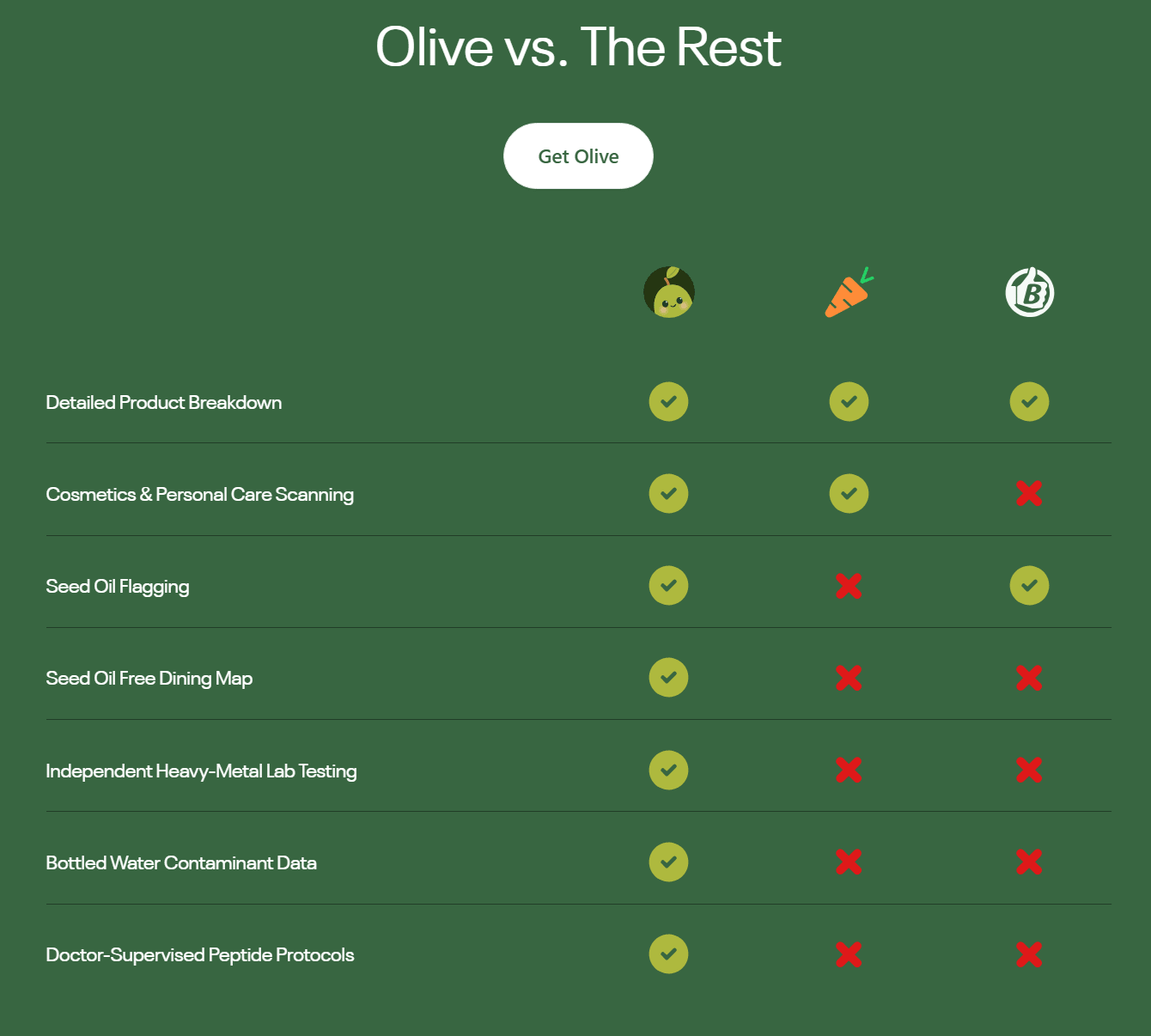
Yuka is a versatile app encompassing both food products and cosmetics. Its core version is completely free, and it relies on a database of millions of products, making it a strong choice. However, it lacks the proprietary testing assets that Olive offers by design.
Bobby Approved is another free option, but the reliability remains questionable due to the lack of transparent expert oversight. Open Food Facts faces a similar gap: its free, crowdsourced database may contain outdated, unreliable, or inaccurate information.
Olive remains the most comprehensive solution among the four reviewed platforms, extending its analysis beyond the grocery aisle and offering an expert-supported, proprietary evaluation system. It also doesn’t stop at helping you build a cleaner cart; it offers help in creating a sustainable lifestyle change through personalized expert guidance.
Make Cleaner Choices With Olive
Olive isn’t a convenient tool for your grocery run. It is a multidimensional companion that helps you see the bigger picture and improve your home and shopping habits as a whole. With a guided process, Olive helps you form long-lasting habits that persist long after you’ve cleaned out your pantry or switched up your skincare routine.
Here’s what you can expect on your Olive journey:
- Scan the barcodes or browse directories spanning food, cosmetics, personal care, household products, and bottled water
- Scan individual products or an entire shelf with Olive’s convenient Shelf Scan feature
- Tap on problematic ingredients to learn about potential health risks and understand why they should be avoided
- View recommended healthier-swap alternatives based on independent analysis, not brand deals
- Create your Olive profile to keep track of your progress, access tailored results, interact with other members of the community, and access your previous scans
- Access personalized peptide protocols for weight loss, including expert-led guidance throughout the process, lab-tested peptides, and prescriptions available across all U.S. states
- Work with your private health coach to receive one-on-one support throughout your lifestyle-improvement journey
Olive was built to expose deceptive labels and help you learn how to make cleaner choices. Take a quick assessment quiz to receive a personalized plan and get started.
I started using the olive app to make better choices for the food I was buying for my family. I knew that the foods we were eating were not the best options, but I wasn't sure how to figure out better alternatives. I cam across Olive and it's been life changing for our family. I'm able to shop in confidence for items that I know will be good for me and my family.

Shop with confidence
- Scan food, personal care and home products
- Independent scores backed by real lab testing
- Cleaner swaps for you, and everyone you shop for
FAQs
Do all food ingredient checkers focus strictly on the label?
No. Unfortunately, the label isn’t the complete source of information about ingredient safety. Hidden contaminants, such as heavy metals, aren’t listed as ingredients, which can make analyzing the label alone misleading.
Can a food ingredient checker accommodate allergies and dietary preferences?
Some can if they’re designed to cater to different allergies, dietary restrictions, and preferences. In apps focused strictly on scanning, personalization may be unavailable or locked behind a paywall.
With Olive, you can set personalized alerts for allergies and dietary restrictions and get notified whenever a scanned product conflicts with your preferences.
Can you check food ingredients without scanning a barcode?
Yes, some ingredient checkers offer store-based filtering, public product directories, or manual searches through a search bar. In addition to individual barcode scanning, Olive’s Shelf Scan feature lets you scan multiple products at once, making the selection process efficient.
Featured image credit: PeopleImages via Shutterstock
Scan Any Grocery Barcode
Scores Brands Can't Buy
Backed by Lab Testing
Cleaner Swaps in the Aisle
Recommended for you
 Alexander Klein
Pore-Clogging Ingredients Checker: Strongest Options & Key Considerations
Learn how pore-clogging ingredient checkers function and how the leading platforms compare across scanning and search capability, methodology, and reliability.
 Alexander Klein
Happy Baby Pouches: Safe and Nutritious? | Parent's Guide
Discover everything you need to know about Happy Baby Pouches: A Parent's Guide to ensuring safe and nutritious choices amidst heavy metals concerns.
100% Independent.
Always.
We never monetize through brand deals, affiliate links, or ads — so you can trust our recommendations are always aligned with our users.
Frequently Asked Questions
What is the Olive app and how does it work?
Olive is a holistic health companion built to help you live cleaner and feel better. Scan a barcode and Olive shows you exactly what is in your food, your personal care products, and the things you bring into your home, then points you to a clean swap that actually makes a difference.
Inside the app you also get:
- Health coaching
- FDA recall alerts
- Prop 65-aligned baby food product lookups
- Proprietary lab testing data on your favorite products
- Video-assisted kitchen detox walkthroughs
- Maps of healthy restaurants and farmers’ markets near you
- Symptom tracking and logging
- Peptide and supplement dosage tracking
How does the Olive food and cosmetic ingredient scanner work?
You scan a product. Olive scores it from 0 to 100 (higher is cleaner), explains in plain language why it scored that way, flags the harmful stuff like seed oils, additives, hidden sugars, contaminants, and endocrine disruptors, and points you to a cleaner swap.
From there, Olive helps you actually change: a 28-day kitchen detox to start, habit building, coaching, and doctor-supervised peptide protocols.
What starts with one scan can end in more energy, a clear head, and a shopping cart you finally trust.
Which products can I scan: food, cosmetics, or bottled water?
All three. Scan food and drinks for the 0 to 100 score, with a breakdown of toxins, additives, processing, seed oils, and sugar.
Scan skincare, makeup, sunscreen, shampoo, and other personal care products and Olive rates every ingredient green, yellow, or red with a plain-language reason for the rating.
Scan bottled water and Olive checks it for contaminants such as fluoride, heavy metals, and microplastics.
How does Olive ensure the accuracy of its scan results?
We do our own independent lab testing for heavy metals (lead, cadmium, mercury, and arsenic) across roughly 400 products so far. That is more testing than most companies do, including Consumer Reports.
Our cosmetic ingredient rating system was built with the head of a chemical toxin working group, so every ingredient carries a documented reason behind its rating.
And Olive is independent. No ads, no affiliates, and we do not take money to change scores. Your subscription is what funds the testing, so Olive answers to you. All of it runs on a database of 10M+ products.
Can Olive be customized to my dietary needs?
Yes. Set your goals, your diet, and your allergies, and every score and swap adjusts to you. Keto, paleo, heart-healthy, Mediterranean, halal, kosher, gluten-free, and dairy-free are all covered.
If you react to gluten, dairy, nuts, soy, or anything else, Olive flags it before it reaches your cart.
Is Olive available for both Android and iOS?
Yes. Olive is live on both. Download Olive on the Apple App Store or get it on Google Play.
Is my data secure when I use Olive?
Yes. Your privacy comes first. Olive protects your personal information with strong security protocols, and your scans, your pantry, and your health details stay yours. You can read the details in our privacy policy.
How do I get started with Olive?
Start with the free quiz. It takes about five minutes, asks about your goals, your symptoms, and what is already in your kitchen, then hands you a personalized plan. Try Olive free.
Start with one scan.
Scan your food, personal care and home products
Independent scores backed by real lab testing
Cleaner swaps for you, and everyone you shop for