Protein calculator for weight loss

Find how much protein you need a day to lose weight, keep your muscle or build more.

Your numbers

Example

Change any box. Your answer updates as you type.

My goal
Strength training, days a weekLifting weights, resistance bands or bodyweight exercises.
About you
I am
ft
lb
Units

Aim for about 125 g of protein a day.

Your range for losing weight: 95 to 155 g a day.

Based on 1.6 g per kg of your weight (172 lb).

Your target, 125 g a day, sits in your range of 95 to 155 g. The RDA minimum is 62 g, and the "1 g per lb" rule would be 172 g.

Your plan

To support losing weight, aim for about 125 g of protein a day, within 95 to 155 g.

  • 31 to 44g

    protein at each main meal.

  • 500

    calories a day from protein.

  • 2×

    the RDA of 62 g, which is a minimum for inactive adults, not a target for weight loss.

Your protein, meal by meal

A 25 / 30 / 35 / 10% split, with one food that gets close.

  • Breakfast31 g1 cup Greek yogurt and 1 egg (29 g)
  • Lunch38 g1 cup lentils with 3 oz canned tuna (40 g)
  • Dinner44 g5 oz chicken breast (44 g)
  • Snack13 g½ cup cottage cheese (12 g)

Protein by goal

Your target for each goal, with the same weight and training.

GoalProtein a day
Lose weightYour goal125 g
Lose fat and build muscle155 g
Build muscle140 g
Maintain95 g
See whyYour target passes all three safety checks

Safety checks

  • FloorPassed

    Your target of 1.6 g per kg is at or above 0.8 g per kg, the RDA.

  • CeilingPassed

    Your target is at or below 2.2 g per kg, the top of the range used in the research.

  • Healthy goal weightPassed

    Your goal weight of 155 lb is a BMI of 25.8, at or above 18.5.

Save your plan

Free. Made on your device. Nothing is sent.

Turn 125 g of protein into a full plan with carbs and fat.Open the macro calculatorProtein protects your lean mass. See how much you have with the body fat calculator.Open the body fat calculator
How we worked this outMethod, formula, assumptions and sources
Method
Grams of protein per kg of a reference weight, by goal, from the ISSN position stand on protein and exercise (Jäger et al., 2017).
Reference weight
172 lb: your weight now (BMI 28.6).
Your g per kg
1.6 g per kg. Lose weight starts at 1.6, in a range of 1.2 to 2.0. Strength training adds 0.2 (1 to 2 days) or 0.4 (3 or more days), never past the top of the range.
Formula
1.6 g × 78 kg = 124.8 g, rounded to the nearest 5 g: 125 g. Calories: 125 × 4 = 500.
Safety checks
Never below the RDA of 0.8 g per kg (1.2 at 65 or over). Never above 2.2 g per kg, the top of the range used in the research. A goal weight must be a BMI of 18.5 or more.
Sources
Jäger et al., ISSN position stand: protein and exercise, 2017. Bauer et al., PROT-AGE study group, 2013. Institute of Medicine, Dietary Reference Intakes, 2005 (the RDA). USDA FoodData Central (food values).

Your details

Goal
Lose weight
Strength training
None
Sex
Woman
Age
38
Height
5 ft 5 in
Weight
172 lb
Goal weight
155 lb

Your plan

  • Aim for about 125 g of protein a day.
  • Your range for losing weight: 95 to 155 g a day.
  • Based on 1.6 g per kg of your weight (172 lb).
  • Breakfast: about 31 g (e.g. 1 cup Greek yogurt and 1 egg, 29 g).
  • Lunch: about 38 g (e.g. 1 cup lentils with 3 oz canned tuna, 40 g).
  • Dinner: about 44 g (e.g. 5 oz chicken breast, 44 g).
  • Snack: about 13 g (e.g. ½ cup cottage cheese, 12 g).
  • That is about 500 calories a day from protein.

This calculator is for information and education only. It is not medical advice and does not diagnose or treat any condition. Talk to your doctor before you change how you eat or exercise, especially if you are pregnant, breastfeeding, under 18, or have a medical condition.

www.oliveapp.com/tools/protein-calculator-for-weight-loss

Guide

How the protein calculator works

Your target is grams of protein per kilogram of body weight, set by your goal. Here is each step, worked for the example: a woman, 38, 5 ft 5 in, 172 lb.

1. Pick grams per kg for your goal

The calculator uses the ranges in the ISSN position stand on protein and exercise (Jäger et al., 2017). To lose weight, it starts at 1.6 g per kg, in a range of 1.2 to 2.0. Losing fat while you build muscle starts at 2.0, building muscle at 1.8, and keeping your weight at 1.2.

Weight172 lb ÷ 2.2046 = 78 kg

Protein1.6 g × 78 kg = 124.8 g

Example125 g a day, rounded to the nearest 5 g

2. Use the right weight

From a BMI of 30, the calculator uses the weight at a BMI of 25 for your height. Your weight now would set a target higher than your muscle needs. If you turn on Base my target on my goal weight, it uses your goal weight instead.

3. Adjust for training and age

Strength training 1 to 2 days a week adds 0.2 g per kg, and 3 or more days adds 0.4, never past the top of the range. At 65 or over, the range never starts below 1.2 g per kg (PROT-AGE, Bauer et al., 2013), because older muscle needs more protein to respond.

4. Why grams, not a % of calories

Muscle needs a set amount of protein, whatever you eat in total. A % of calories falls when you eat less, just when you need protein most. The macro calculator for weight loss sets protein in grams first, then fills the rest with carbs and fat.

Do you need 1 gram per pound?

The gym rule says eat 1 g of protein for every pound you weigh. That is 2.2 g per kg, the very top of the range used in the research. For most people losing weight, it is more than they need.

1 g per lb172 lb × 1 g = 172 g

Calculator1.6 g × 78 kg = 125 g

Difference47 g a day above her target, and above the top of her range (155 g)

Extra protein above your range is not harmful for most healthy people, but it adds calories and crowds out fiber-rich foods. If you train hard while you lose fat, the calculator already moves you up: to 155 g for the example.

Why protein matters when you're losing weight

  1. It keeps you fuller. Protein is the most filling of the three macronutrients. Meals with more of it help you eat less without feeling hungry, which makes a calorie deficit easier to keep.

  2. It helps you keep muscle. In a deficit, your body can break down muscle as well as fat. Enough protein, with strength training, protects your lean mass, so more of what you lose is fat.

  3. It costs more to digest. Your body uses about 20 to 30% of protein's calories to digest it, against 5 to 10% for carbs and 0 to 3% for fat. It is a small help on top of your calorie deficit.

For recovery and body composition, Olive also offers a Metabolic and Cellular Optimization protocol.

High-protein foods and how much protein they have

Animal foods pack the most protein per serving, and beans, lentils and soy close the gap for plant-based eaters.

Protein in everyday foods, per typical serving
FoodServingProtein
Chicken breast, cooked4 oz (113 g)35 g
Salmon, cooked4 oz (113 g)25 g
Tuna, canned in water3 oz (85 g)22 g
Shrimp, cooked3 oz (85 g)20 g
Eggs, large2 eggs13 g
Greek yogurt, plain nonfat1 cup (227 g)23 g
Cottage cheese, 2%1 cup (226 g)24 g
Firm tofu½ cup (126 g)20 g
Lentils, cooked1 cup (198 g)18 g
Edamame, shelled1 cup (155 g)18 g

Values from USDA FoodData Central, rounded to the nearest gram.

Scan foods with the Olive app to check what's in them before you buy.

When hunger makes protein hard
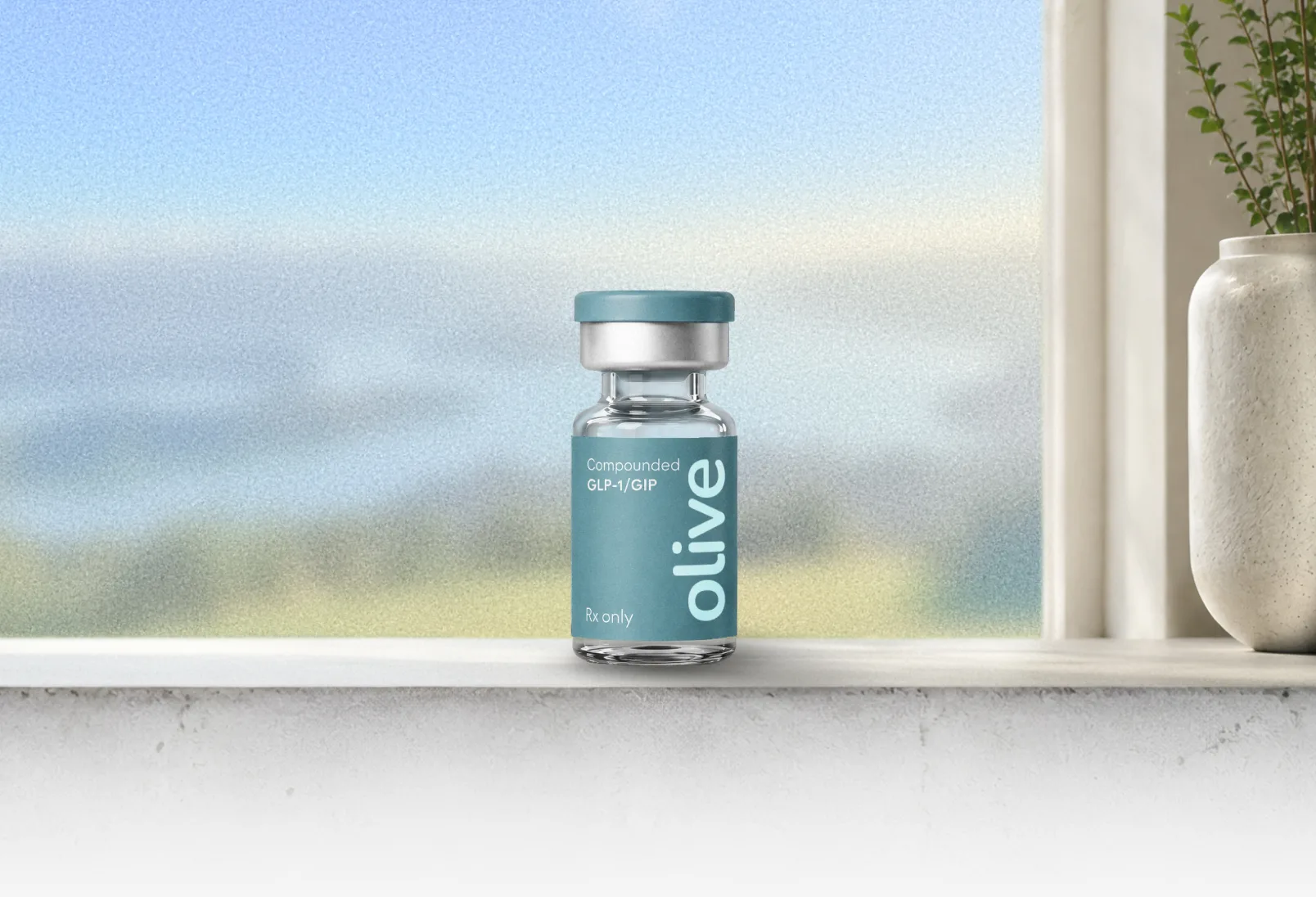
A medication vial on a sunlit windowsill

Getting enough protein is easier when you're not fighting hunger all day. GLP-1 treatment works on appetite itself, and protein helps you keep muscle while you lose weight.

14.9%
Average weight loss at 68 weeks on semaglutide 2.4 mg. STEP 1, Wilding et al., NEJM 2021.
20.9%
Average weight loss at 72 weeks on tirzepatide 15 mg. SURMOUNT-1, Jastreboff et al., NEJM 2022.

Both trials paired the medicine with diet and activity changes. Results vary.

Results vary, and a licensed clinician decides if treatment is right for you.

Compounded medications are tailored to a patient's needs and are not reviewed or approved by the FDA for safety or effectiveness. Prescription required. Eligibility, prescribing, and dosing are determined individually by a licensed clinician based on your medical history. Treatment is not appropriate for everyone. Results vary.

Protein calculator questions

Can you eat too much protein?

For most healthy adults, intakes up to about 2.2 g per kg a day are well studied and safe, which is why the calculator never goes above it. More than that adds calories without more benefit for muscle. If you have kidney disease, talk to your doctor before you eat more protein.

Do women need less protein than men?

Per kilogram, women and men need the same. Women usually weigh less, so their target in grams is lower. The example woman at 172 lb needs about 125 g a day to lose weight; a man at the same weight would get the same number.

Does protein powder count toward my target?

Yes. A scoop of whey or plant protein powder usually has 20 to 25 g, and it counts the same as protein from food. It is a handy way to fill a gap, but whole foods also bring fiber, vitamins and minerals.

Can I get enough protein on a plant-based diet?

Yes. Tofu, tempeh, edamame, lentils, beans and seitan are all good sources. Plant proteins are a little less complete, so mix several sources across the day and aim for the upper half of your range.

Does it matter when I eat my protein?

Spreading it out works better than one large meal. About 25 to 40 g at each main meal gives your muscles a steady supply. For the example, that is 31 g at breakfast, 38 g at lunch and 44 g at dinner.

Do I need more protein on days I train?

Not much. Your muscles rebuild for a day or two after a workout, so a steady daily target works better than changing it day to day. Set Strength training to how often you train each week, and the calculator raises your target to match.