Guide
How the body fat calculator works
Every number in your report comes from a published formula you can check by hand. This guide shows how each one is made, how to measure, and what a healthy body fat percentage is.
1. With a tape measure: the US Navy method
This body fat percentage calculator ranks the US Navy method first (Hodgdon and Beckett, Naval Health Research Center, 1984). It uses your height and a few tape measurements: neck and waist, plus hips for women. The formula turns them into body density, then into body fat percentage. Because it uses your own measurements, it sees where your body carries fat.
Women%BF = 495 ÷ (1.29579 − 0.35004 × log10(W + H − N)
+ 0.22100 × log10(Ht)) − 450
Men%BF = 495 ÷ (1.0324 − 0.19077 × log10(W − N)
+ 0.15456 × log10(Ht)) − 450
ExampleW + H − N = 158.75, Ht = 165.1, so %BF = 37.4%
W waist, H hips, N neck, Ht height, all in centimeters. The example is the woman from the calculator: 38, 5 ft 5 in (165.1 cm), 172 lb, waist 34 in (86.36 cm), hips 42 in (106.68 cm), neck 13.5 in (34.29 cm).
2. Without a tape measure
No tape? Choose No tape measure on the calculator, and it works without measurements. It uses the ADA formula, also called CUN-BAE (Gómez-Ambrosi et al., Diabetes Care, 2012, a journal of the American Diabetes Association). It needs only your BMI, age and sex, and is accurate to about ±4.7 points.
The report also checks a third formula, BMI-based (Deurenberg et al., British Journal of Nutrition, 1991): %BF = 1.20 × BMI + 0.23 × age − 10.8 × sex − 5.4, with men 1 and women 0. It cannot tell muscle from fat, so it misreads muscular people and older adults. For the example, the ADA formula gives 40.2% and the BMI-based formula 37.7%. All three agree within 3 points.
3. From body fat % to your goal weight
Once the calculator has your body fat %, the rest is simple math. Pick a goal under your answer, and it works as a goal body fat calculator. It assumes you keep all your lean mass as you lose fat.
Fat massweight × body fat % = 172 × 0.374 = 64.33 lb
Lean massweight − fat mass = 172 − 64.33 = 107.67 lb
Goal weightlean ÷ (1 − target) = 107.67 ÷ 0.72 = 149.54 lb
Fat to loseweight − goal weight = 172 − 149.54 = 22.46 lb
Worked to two decimals here. The calculator shows 64.3 lb of fat and 107.7 lb of lean mass, and rounds the goal to a whole pound: 150 lb, with 22 lb of fat to lose.
All three are estimates. DEXA, a low-dose X-ray scan, is the reference standard for body composition. If you have a value from DEXA, a smart scale (BIA) or skinfold calipers, add it under Edit, next to your details. The calculator then uses it in place of the estimate for fat mass, lean mass and goal weight.
How to take your measurements
A body fat calculator with measurements is only as good as your tape. Follow the same routine every time, and your results track real change, not tape noise.
Neck. Just below your larynx, the bump at the front of your throat. Let the tape slope slightly down toward the front. Keep your head level and your neck relaxed.
Waist. Women: the narrowest point between your ribs and hips. Men: level with your navel. Keep the tape parallel to the floor, and measure after a normal breath out.
Hips, women only. Around the widest part of your buttocks, with your feet together. Keep the tape level all the way around. A mirror helps you check.
Before you measure
- Measure in the morning, before you eat or drink.
- Use a soft, non-stretch tape on bare skin.
- Keep the tape snug, without pressing into the skin.
- Stand tall and relaxed. Do not suck in or flex.
- Measure each site three times and use the average.
- Round to the nearest half inch, or the nearest centimeter.
A small tape error matters. For the example, 1 extra inch on the waist moves the result from 37.4% to 38.6%. 1 extra inch on the neck takes it down to 36.2%. Keep the same routine every time, and compare like with like.
Healthy body fat percentage for women and men
There is no single ideal body fat percentage. Use two references together: the categories this calculator uses, from the American Council on Exercise (ACE), and a healthy range for your age (Gallagher et al., American Journal of Clinical Nutrition, 2000).
| Category (ACE) | Women | Men |
|---|---|---|
| Essential fat | 10 to 13% | 2 to 5% |
| Athletes | 14 to 20% | 6 to 13% |
| Fitness | 21 to 24% | 14 to 17% |
| Average | 25 to 31% | 18 to 24% |
| Above average | 32% and upExample | 25% and up |
ACE names the top band obese. This calculator calls it above average.
Healthy range by age
| Age | Women | Men |
|---|---|---|
| 20 to 39Example | 21 to 33% | 8 to 20% |
| 40 to 59 | 23 to 34% | 11 to 22% |
| 60 to 79 | 24 to 36% | 13 to 25% |
Ages 18 and 19 use the 20 to 39 range. Ages 80 and up use the 60 to 79 range. Women need more essential fat than men, so their ranges sit higher at every age.
Why body fat says more than the scale or BMI
BMI only knows your height and weight. It cannot tell muscle from fat, or show where the fat sits. That is why a BMI and body fat calculator side by side tells you more than either number alone.
Take two women who are both 5 ft 5 in and 172 lb. Both have a BMI of 28.6. One carries 64.3 lb of fat (37.4%, above average). The other carries 50 lb (29.1%, average). Same scale weight, same BMI, a 14.3 lb difference in fat.
Fat stored around the waist is linked with a higher risk of type 2 diabetes and heart disease. When you track body fat, a month where the scale barely moves can still be a good month: you lost fat and kept muscle.
When your result looks off
Every body fat estimate has limits. If a number surprises you, work through these checks first.
- It looks too high or too low
- Start with the tape. Position and tension cause the biggest swings. Your waist must measure larger than your neck. A result under 2% or over 60% means a measurement needs a second look.
- You are very muscular or very lean
- BMI-based formulas read muscle as fat, so they overestimate muscular builds. Very lean builds can push the US Navy method off too. A DEXA scan gives you a reliable baseline.
- Your smart scale disagrees
- Smart scales use bioelectrical impedance (BIA), which shifts with hydration, meals, exercise and time of day. If a measured value and the estimate differ by more than 10 points, re-check your measurements.
- You are pregnant
- These formulas do not apply during pregnancy. Ask your doctor or midwife which measures to track instead.
- Your goal looks out of reach
- Raise the target by a few points. Focus on losing fat while you keep lean mass, not on a scale number. If you have about 22 lb (10 kg) or more of fat to lose, talk to a clinician about the right support.
- Your target is very low
- The calculator will not set a goal in or below essential fat, which tops out at 13% for women and 5% for men. It offers the lowest healthy target for your age instead. A target in the athlete range takes structured training, not diet alone.
When the gap is big, appetite is the hard part
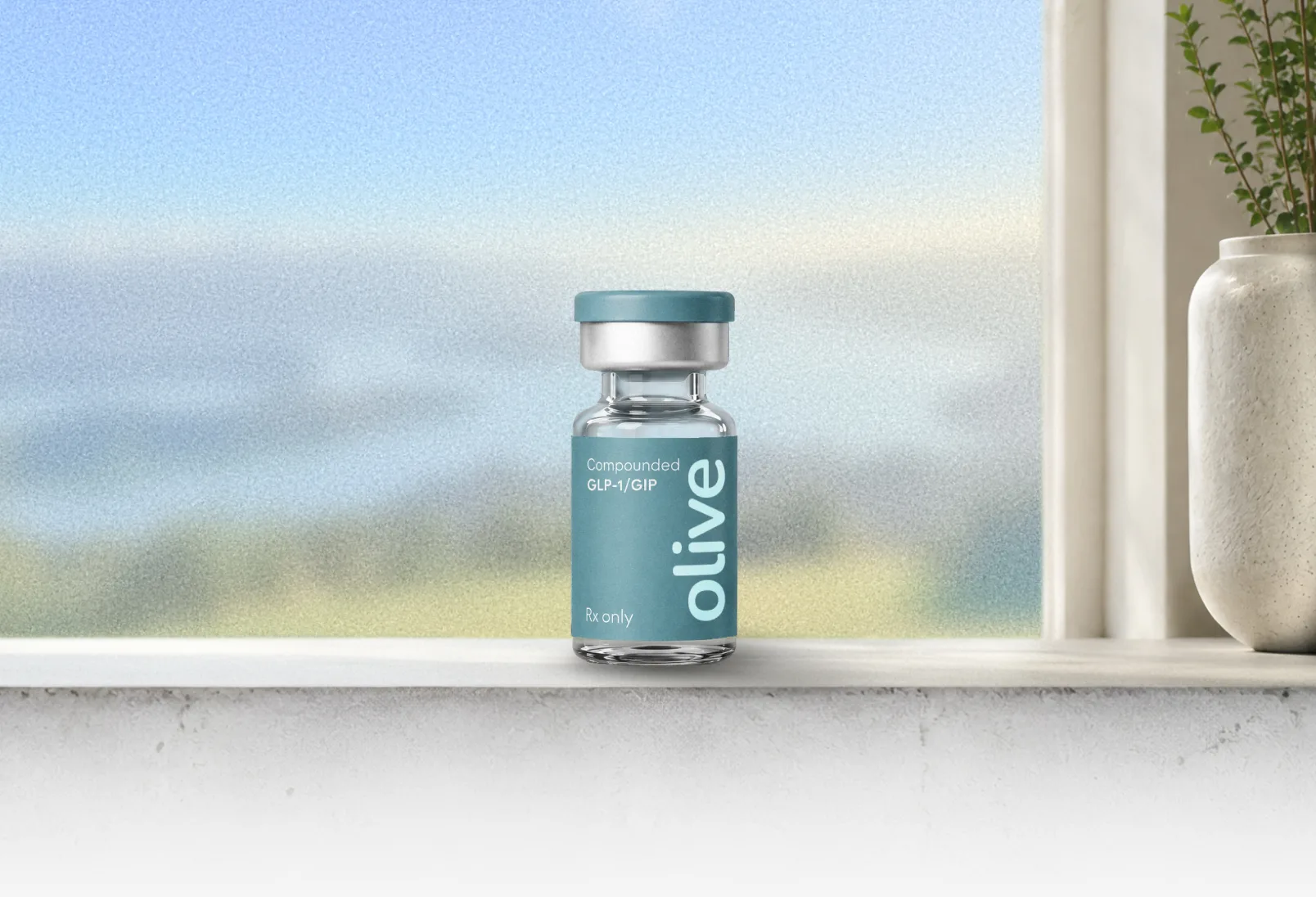
Fat loss math is simple on paper. Appetite, cravings and constant food noise are where many plans stall, even when you know exactly what to eat.
GLP-1 medicines act on the hunger and fullness signals behind that. You feel full sooner and think about food less, so a steady deficit can feel possible again.
- 14.9%
- Average weight loss at 68 weeks on semaglutide 2.4 mg. STEP 1, Wilding et al., NEJM 2021.
- 20.9%
- Average weight loss at 72 weeks on tirzepatide 15 mg. SURMOUNT-1, Jastreboff et al., NEJM 2022.
Both trials paired the medicine with diet and activity changes. Results vary.
Habits first. A clinical push when your body needs it. With about 22 lb (10 kg) or more of fat to lose, ask about medical weight loss. For the last few points, or for keeping weight off, GLP-1 microdosing is a lower-dose approach. In both cases, a licensed clinician decides if treatment is right for you.
Compounded medications are tailored to a patient's needs and are not reviewed or approved by the FDA for safety or effectiveness. Prescription required. Eligibility, prescribing, and dosing are determined individually by a licensed clinician based on your medical history. Treatment is not appropriate for everyone. Results vary.
Lose fat and keep your lean mass
When you lose weight, part of it can come from lean mass, mostly muscle and water. That is true on a diet, and it is true on a GLP-1 medicine. Lean mass keeps you strong, and it drives the calories you burn at rest. The Katch-McArdle formula predicts resting burn from lean mass alone, and the weight loss calculator by date uses it when you add your body fat %.
Eat protein at every meal. Protein gives your body what it needs to hold on to muscle while you eat less. Your Olive clinician can set a daily target that fits your body and health history.
Train for strength. Do muscle-strengthening work on 2 or more days a week, as the Physical Activity Guidelines for Americans advise. Bands, weights and bodyweight moves all count.
Track composition, not just weight. Re-run this body composition calculator every 4 weeks with the same tape routine. If body fat falls while lean mass holds, your plan is working, even in a slow week on the scale.
Olive clinicians check in on your progress and adjust your plan as your body changes. Between check-ins, the Olive app coaches the daily habits that protect muscle: protein at meals, movement and sleep. For recovery and body composition, Olive also offers a Metabolic and Cellular Optimization protocol. Walking more helps too: the walking weight loss calculator shows how many steps it takes.
40,000+ five-star reviews