Weight loss calculator by date
Pick a goal weight and a date. Get the daily calories it takes, checked against safe limits.
- Daily calories and deficit
- Week-by-week timeline
- Earliest safe date if needed
Open calculatorMifflin-St Jeor
Four free weight loss tools help you plan a goal date, estimate your body fat, set a daily step goal and see an AI photo of you at your goal. Each one uses published data, names its method on every result, and checks your plan against safe limits.
Pick a goal weight and a date. Get the daily calories it takes, checked against safe limits.
Estimate your body fat with a tape measure, or from height and weight alone. Then see your weight at a goal body fat %.
See how many steps a day it takes to reach your goal, based on your weight and your pace.
Add a photo of yourself and see what you would look like at your goal weight, along with how long it would take to reach your goal.
Each one shows the formula behind your number, checks your plan against safe limits, and stores nothing. The calculators run on your device; the simulator sends your photo and numbers to OpenAI only to make your image.
Every result names the formula behind it, from Mifflin-St Jeor to the Compendium of Physical Activities, so you can check the source.
Every plan is checked before you see it. If your date is too soon, you see why, and one tap gives you a safe date or a goal you can reach by then.
The calculators run in your browser, and Olive stores nothing. To make its image, the simulator sends your photo, sex, height, weight and goal to OpenAI, which keeps API data for up to 30 days. There is no account and no email.
Medical weight loss with Olive
A calorie plan works only if you can keep to it. When hunger and cravings make that hard, GLP-1 treatment works on appetite itself. Results vary, and a licensed clinician decides if treatment is right for you.
Compounded medications are tailored to a patient's needs and are not reviewed or approved by the FDA for safety or effectiveness. Prescription required. Eligibility, prescribing, and dosing are determined individually by a licensed clinician based on your medical history. Treatment is not appropriate for everyone. Results vary.
Averages from two clinical trials of brand-name medications, both alongside lifestyle changes. Results vary.
Quick answers on sign-up, accuracy, body fat and steps. Each calculator page explains its own method in full.

Olive is an AI health companion that helps people get unstuck with their body.
No. All four free health tools work without an account or an email address. The calculators run in your browser, and you see your full result on the page. To make its image, the simulator sends your photo, sex, height, weight and goal to OpenAI, which keeps API data for up to 30 days. Olive stores none of it. On the three calculators, you can download your plan as a PDF, print it or copy a summary to keep it.
Every weight loss calculator gives an estimate. Ours use published formulas, such as Mifflin-St Jeor (1990) for calorie needs, and each result names the method behind it. A smaller body needs fewer calories, so run the calculator again after every 5% you lose.
With a soft tape measure, use the US Navy method (Hodgdon and Beckett, 1984). It is the most precise method in our body fat calculator, with a margin of about 3.5 points either way. You measure your neck and waist, plus your hips if you are a woman. A DEXA scan is the reference standard if you want a measured number.
It depends on your weight, your pace and your goal, so the walking calculator asks for all three. For example, a 172 lb woman who walks briskly burns about 32 extra calories per 1,000 steps. Going from 5,000 to 10,000 steps a day, she would lose about 0.3 lb a week from walking alone, or about 0.8 lb a week if she also eats 250 calories less.
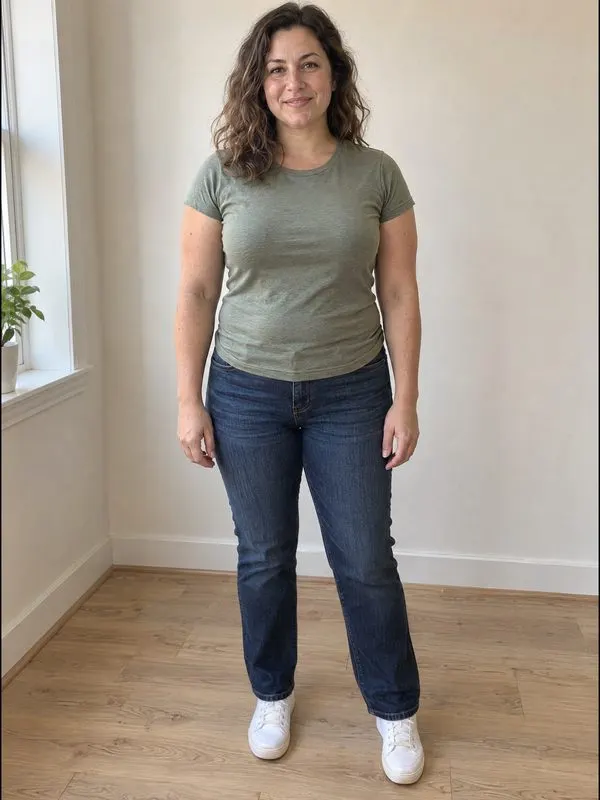
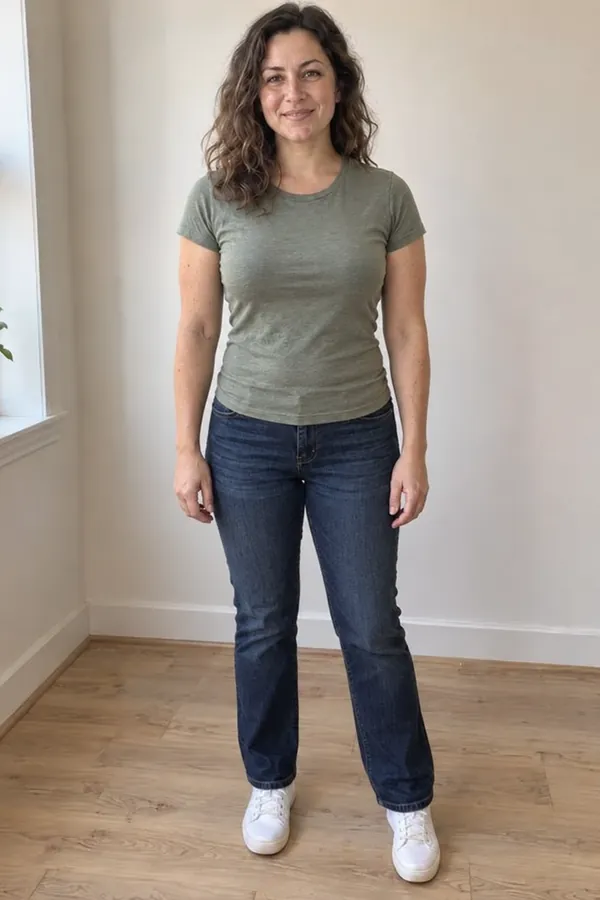 AI example, not a real person