Yuka vs. EWG: Which App Offers Better Clean-Living Guidance?
Use this Yuka vs. EWG comparison to learn about each app’s scanning capabilities, product scope, and overall reliability. Find a holistic alternative to both.
Sign up for Olive
Both Yuka and EWG offer meaningful guidance for scrutinizing the products that enter your household and making healthier choices. Their functions, such as barcode scanning and product database searches, are similar, but they still differ across core areas, including product scope, rating methodology, and scientific support.
In this Yuka vs. EWG comparison, we present both options in detail and weigh their advantages and limitations. We also explore Olive, an alternative that may be better suited to a strategy focused on sustainable lifestyle improvement.
- What Yuka and EWG offer
- How they compare across key areas, including rating systems and accessibility
- Which app may be a stronger option
Live cleaner and start feeling better today.
Sign up for OliveWhat Is Yuka?
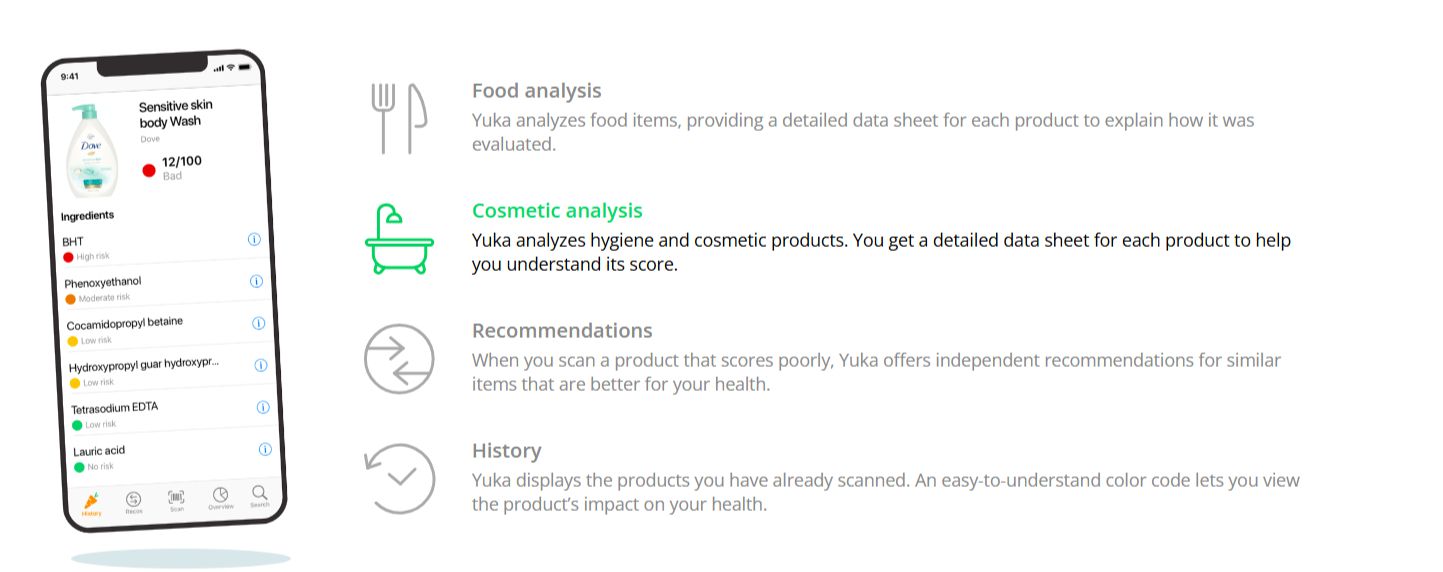
Yuka is a France-based label-scanning app focused on deciphering labels of food products and cosmetics. You scan an item, get a score, and receive recommendations for healthier alternatives to poorly rated products.
One of Yuka’s essential principles is complete independence. The company claims to accept no paid collaborations, advertisements, or any brand endorsements that could compromise the objectivity of its rating methodology.
Yuka publishes its revenue breakdown and complete balance sheet publicly, supporting a transparent business model. It’s funded entirely by its users through three main revenue sources:
- Paid subscriptions
- Books and calendars
- Other services
Yuka’s scientific team includes a toxicologist, a food nutrition engineer, and a registered dietitian, making professional expertise one of the app’s stronger points. The company states that its rating method, explanations, and cleaner-swap recommendations draw on scientific studies and the opinions of respected organizations.
Bonus reads: Explore our other Yuka guides below:
What Is EWG?
EWG, short for the Environmental Working Group, is an American nonprofit organization founded in 1993. Its focus on safer, healthier, and more environmentally conscious living encompasses food and cosmetics, as well as:
- Water
- Farming and agriculture
- Household products
EWG’s primary goal is to raise awareness of potentially toxic chemicals present in food, water, self-care and household products, and every other item that enters the home. The organization also aims to pressure industries and policymakers to recognize and adopt higher standards, highlighting important environmental concerns and the need for safer products.
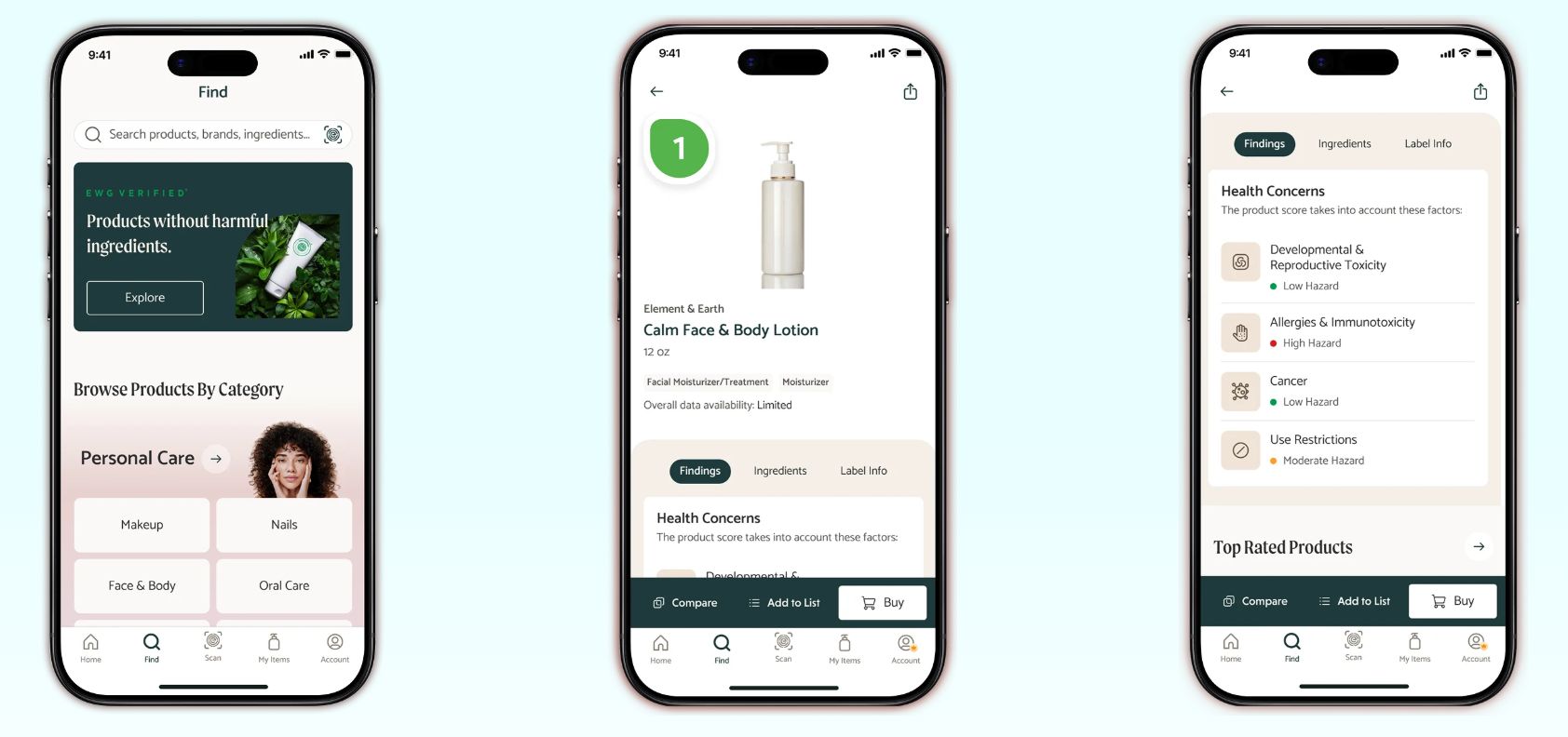
The Healthy Living app is EWG’s barcode-scanning tool designed to simplify shopping for cleaner products. It combines three free databases with ~200,000 food, personal-care, and cleaning products, including:
- Skin Deep: Covering more than 130,000 personal-care items and their ingredients
- Food Scores: Containing over 150,000 food products, rated from 1 for the best picks to 10 for the worst
- Guide to Healthy Cleaning: Comprising cleaning products across several categories, including dishwashing, kitchen, laundry, furniture, and floor care
Instant Barcode Scan
Allergen Detection
Clear Ingredient Insights
Get Personalized Suggestions
EWG vs. Yuka: Complete Review
While EWG and Yuka may overlap in certain areas, their approaches to product scanning and clean-living support differ. To understand how these two apps function in practice, let’s compare them across four vital aspects:
- Product scope and scanning capabilities
- Rating methodology
- Pricing and accessibility
- User reviews
1. Product Scope and Scanning Capabilities
EWG’s Healthy Living app allows you to scan products across personal-care, food, and cleaning categories. You can scan a product’s barcode to obtain information about its ingredients, or manually search for specific products, brands, or ingredients.
You can also search for specific products within broader categories, which are divided into smaller sections for easier navigation. For example, the main personal-care category is further broken down into makeup, nails, face and body, and oral care.
Yuka focuses solely on food and cosmetics, excluding household cleaning products. You can scan a product’s barcode or search for it manually, though the search bar is reserved for the app's paid version. Still, the free option places no monthly limits on barcode scans.
One important distinction between the two apps is database size. EWG Healthy Living covers more than 200,000 products, while Yuka’s directory contains approximately 6 million food and cosmetic products combined.
In conclusion, EWG offers broader category coverage, but Yuka relies on a substantially larger product database.
2. Rating Methodology
Yuka and the EWG Healthy Living app both apply different rating methods depending on the product category. However, their scoring systems differ substantially.
EWG Healthy Living
When you scan or manually search for a product, the EWG Healthy Living app evaluates it based on ingredient safety, potential health concerns, and transparency. The app considers potential health effects and environmental impact.
Here’s what the scoring system looks like based on product category:
Product category | Scoring dimension & What it considers |
|---|---|
Food scoring |
|
Cosmetics scoring |
|
Cleaning product scoring |
|
Yuka
Yuka’s scoring system for food products is based on three key criteria:
- Nutritional quality (60% of the total score): Based on Nutri-Score, a science-backed nutrition label system, a product is evaluated according to its sugar, sodium, protein, calories, fiber, and other nutritional components’ presence.
- Presence of additives (30% of the total score): Based on current scientific findings, including assessments from EFSA and IARC, as well as independent studies, each additive receives a risk level: green for no risk, yellow for limited risk, orange for moderate risk, and red for high risk.
- Organic certification (10% of the total score): A bonus filter stating whether the product holds an official national or international organic certification.
The cosmetic product rating system is also ingredient-based, similar to the additive evaluation. The highest-risk ingredient has the greatest impact on the product’s overall rating.
The color-coded ingredient risk categories are:
- High risk (red)
- Moderate risk (orange)
- Low risk (yellow)
- Risk-free (green)
The cumulative risk level of a product is determined by the potential health effects of its ingredients, including endocrine-disrupting, allergenic, irritant, carcinogenic, and pollutant effects. The presence of a single high-risk ingredient in an item, regardless of the remaining components, automatically places it in the red category.
3. Pricing and Accessibility
The Healthy Living app’s core features are completely free, including unlimited barcode scanning, manual searches by product name, alternative recommendations, and EWG scores drawn from combined directories encompassing food, cosmetics, sunscreen, and cleaning products. However, the app also offers paid premium features, including:
- Ingredient-based preferences for favorite or avoided components, reflected as badges on searched products
- More detailed ingredient insights
- Side-by-side product comparisons
The premium tier is currently priced at $19.99 per year. EWG states that the app will continue to offer a free version.
Yuka’s barcode scanning, alternative recommendations, and food and cosmetic product scores are free, while Yuka Premium unlocks advanced features such as manual product searches, offline mode, and personalized alerts based on your dietary preferences.
Since Yuka operates on an open pricing model, its annual premium fee is flexible, starting at 10€ (~$11.38).
Both apps are available through the App Store and Google Play. Yuka is currently available in the U.S., Canada, Australia, and several European countries, including the U.K., France, Spain, and Italy.
EWG Healthy Living is geared toward the U.S. market and primarily evaluates products available in the U.S. Its database and barcode-scanning functionality may therefore be less comprehensive in other regions.
4. User Reviews
EWG’s Healthy Living app holds an overall App Store rating of 3.9 stars based on ~2,800 impressions. Satisfied users often cite the app's informative product analysis, guidance on removing heavily processed foods, and support for reducing potentially harmful products in the household. Less favorable reviews mention confusing product categorization and filtering options, a potentially misleading ranking system, and perceived bias in product recommendations.
Yuka holds a considerably higher App Store rating of 4.8 stars based on ~97,000 ratings. Reviewers praise the app’s convenience, ease of use, and reliability in evaluating products. Complaints typically mention a limited number of highly rated recommendations and a lack of scoring customization based on user preferences.
Yuka App vs. EWG: Which Is Better?
Here’s a side-by-side comparison of Yuka and EWG’s key features and limitations:
| Yuka App | EWG’s Healthy Living App |
|---|---|
| Scans food and cosmetics | Scans food, cosmetics, and household cleaning products |
| Operates a large database of around 6 million products | Offers a directory that contains ~200,000 products |
| Available internationally | Focus on products sold in the U.S. |
| Manual product search available only through the paid version | Manual product search by product, category, and ingredient is free |
| Open-pricing model starting at 10€ (~$11.38)/year | Premium subscription priced at $19.99/year |
| Ratings based on scientific research and assessment from established organizations | Ratings based on EWG’s proprietary methodology |
| Completely independent, with no brand influence on scores | Highlights products carrying the EWG Verified mark, for which companies can apply if their products meet the organization’s standards |
| Higher App Store rating | Lower App Store rating compared to Yuka |
The decision between the two depends on your preferences regarding product scope, rating system, and overall app functionality.
Still, neither barcode scanner offers consistent support for lasting lifestyle changes beyond building a cleaner shopping cart. Olive is a holistic health companion that goes beyond product evaluation and recommendations. It offers expert guidance and practical support for developing clean-living habits that last.
Try Olive for free on iOS or Android.
Reclaim Control Over Your Health With Olive
Olive is a multidimensional health companion that helps you detect the toxic load in your home, remove it, and then rebuild with cleaner products. That isn’t a one-time fix but an interconnected system that helps you see through the promotional fog, understand potential risks, make sustainable changes, and build a cleaner household altogether.
Olive doesn’t rely on paid partnerships, brand influence, or misleading labels. It’s 100% independent, supporting its methodology with independent laboratory testing across more than 400 products, surpassing even Consumer Reports’ directory.
Olive’s Flagship Features
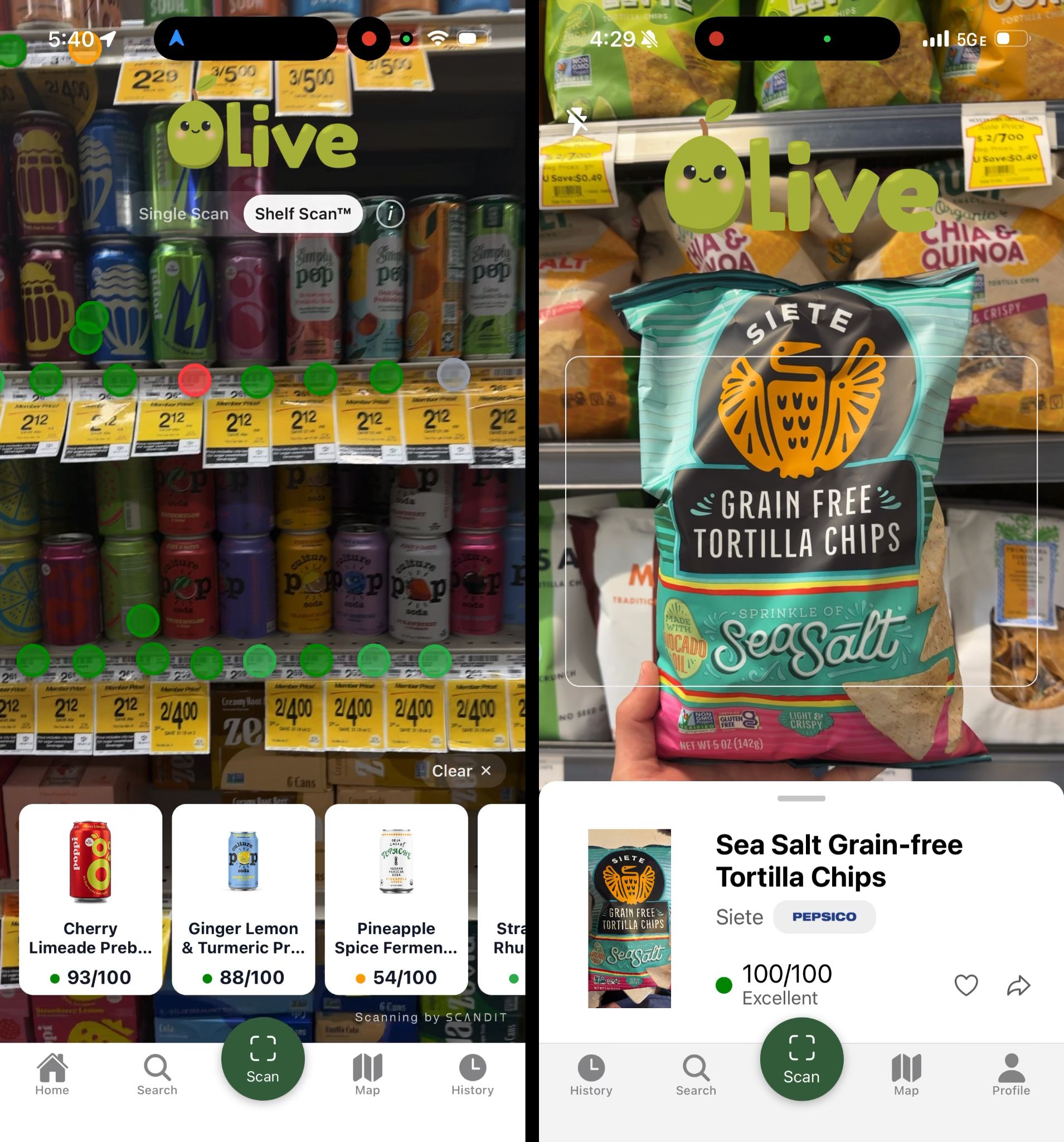
Olive allows you to scan the product, view its score with a plain-language explanation of the rating, and find healthier swaps in the same category. The main features of the app include:
- Scan food products and receive a score from 0 (worst) to 100 (best)
- Scan cosmetics and household products to detect toxins and contaminants affecting your health
- Scan bottled water to check for any present contaminants, such as fluoride and microplastics
- Receive in-app FDA recall alerts to stay informed about flagged products and ingredients
- Create a social profile to keep up with your and other Olive users’ progress and stay motivated throughout the process
- Start your journey with the 28-Day Kitchen Detox Challenge to clean up the pantry, find cleaner swaps, and track your and your family’s symptoms, with a full refund if you experience no noticeable improvement
- Access doctor-supervised peptide protocols and prescriptions through clinicians in all U.S. states
- Get 1:1 health guidance based on your individual needs, goals, and concerns
Building a cleaner home can feel like fighting invisible enemies because many products are designed to work against you, and the labels are there to hide it. Olive translates the complicated ingredient lists and puts you back in charge. Complete this quick quiz to try Olive for free.
I've been scanning the foods my daughter loves and I'm truly shocked at how many of them that I thought were healthy are actually really bad 😭 but I'm SO glad I know that now!! And I can feel confident because I know Olive is independent (unlike so many other apps) so the label readings are actually honest!

See what the label doesn't tell you
- Scan food, personal care and home products
- Independent scores backed by real lab testing
- Cleaner swaps for you, and everyone you shop for
Featured image source: AYO Production via Shutterstock
Instant Barcode Scan
Allergen Detection
Clear Ingredient Insights
Get Personalized Suggestions
Recommended for you
 Alexander Klein
Pore-Clogging Ingredients Checker: Strongest Options & Key Considerations
Learn how pore-clogging ingredient checkers function and how the leading platforms compare across scanning and search capability, methodology, and reliability.
 Alexander Klein
Happy Baby Pouches: Safe and Nutritious? | Parent's Guide
Discover everything you need to know about Happy Baby Pouches: A Parent's Guide to ensuring safe and nutritious choices amidst heavy metals concerns.
100% Independent.
Always.
We never monetize through brand deals, affiliate links, or ads — so you can trust our recommendations are always aligned with our users.
Frequently Asked Questions
What is the Olive app and how does it work?
Olive is a holistic health companion built to help you live cleaner and feel better. Scan a barcode and Olive shows you exactly what is in your food, your personal care products, and the things you bring into your home, then points you to a clean swap that actually makes a difference.
Inside the app you also get:
- Health coaching
- FDA recall alerts
- Prop 65-aligned baby food product lookups
- Proprietary lab testing data on your favorite products
- Video-assisted kitchen detox walkthroughs
- Maps of healthy restaurants and farmers’ markets near you
- Symptom tracking and logging
- Peptide and supplement dosage tracking
How does the Olive food and cosmetic ingredient scanner work?
You scan a product. Olive scores it from 0 to 100 (higher is cleaner), explains in plain language why it scored that way, flags the harmful stuff like seed oils, additives, hidden sugars, contaminants, and endocrine disruptors, and points you to a cleaner swap.
From there, Olive helps you actually change: a 28-day kitchen detox to start, habit building, coaching, and doctor-supervised peptide protocols.
What starts with one scan can end in more energy, a clear head, and a shopping cart you finally trust.
Which products can I scan: food, cosmetics, or bottled water?
All three. Scan food and drinks for the 0 to 100 score, with a breakdown of toxins, additives, processing, seed oils, and sugar.
Scan skincare, makeup, sunscreen, shampoo, and other personal care products and Olive rates every ingredient green, yellow, or red with a plain-language reason for the rating.
Scan bottled water and Olive checks it for contaminants such as fluoride, heavy metals, and microplastics.
How does Olive ensure the accuracy of its scan results?
We do our own independent lab testing for heavy metals (lead, cadmium, mercury, and arsenic) across roughly 400 products so far. That is more testing than most companies do, including Consumer Reports.
Our cosmetic ingredient rating system was built with the head of a chemical toxin working group, so every ingredient carries a documented reason behind its rating.
And Olive is independent. No ads, no affiliates, and we do not take money to change scores. Your subscription is what funds the testing, so Olive answers to you. All of it runs on a database of 10M+ products.
Can Olive be customized to my dietary needs?
Yes. Set your goals, your diet, and your allergies, and every score and swap adjusts to you. Keto, paleo, heart-healthy, Mediterranean, halal, kosher, gluten-free, and dairy-free are all covered.
If you react to gluten, dairy, nuts, soy, or anything else, Olive flags it before it reaches your cart.
Is Olive available for both Android and iOS?
Yes. Olive is live on both. Download Olive on the Apple App Store or get it on Google Play.
Is my data secure when I use Olive?
Yes. Your privacy comes first. Olive protects your personal information with strong security protocols, and your scans, your pantry, and your health details stay yours. You can read the details in our privacy policy.
How do I get started with Olive?
Start with the free quiz. It takes about five minutes, asks about your goals, your symptoms, and what is already in your kitchen, then hands you a personalized plan. Try Olive free.
Start with one scan.
Scan your food, personal care and home products
Independent scores backed by real lab testing
Cleaner swaps for you, and everyone you shop for