Home/Blogs/Bad Ingredients in Sunscreen: Do Sun Protection Products Come With Risks?
Lab Test SummaryHealth & Wellness
Bad Ingredients in Sunscreen: Do Sun Protection Products Come With Risks?
Find out common bad ingredients in sunscreen that can damage your health, skin, and the environment. Learn about better and more sustainable alternatives.
Know what's really in your personal care and home products.
While sun protection is receiving the well-deserved recognition in both medical and beauty conversations, one concern often gets overlooked: the presence of bad ingredients in sunscreen products.
A product’s effectiveness in protecting your skin from UV damage doesn’t necessarily reflect its overall impact on your health. The same protective barrier may expose your skin to UV filters, synthetic compounds, and endocrine disruptors, carrying risks that are rarely stated on the label.
This guide explores the importance of looking beyond the SPF number, provides a detailed list of toxic sunscreen ingredients, and presents a science-backed way to find clean and equally effective products.
What You Will Learn
How harmful sunscreen ingredients may affect your health
Which sunscreen ingredients are bad for you
How to identify better sunscreen products
Know what's really in your personal care and home products.
Why You Should Be Wary of Harmful Ingredients in Sunscreen
Few skincare products require such vigilant, frequent, and layered application as sunscreen. Particularly during summer months, you need to reapply sunscreen frequently to maintain protection against harmful UV rays and prevent sun damage.
Most adults need at least one ounce per application to cover all skin not protected by clothing. The amount can vary depending on body size and the amount of skin exposed. For the face alone, the recommended amount is at least one teaspoon, or roughly enough to cover the full length of your index and middle fingers. That means regular use of sunscreen with bad ingredients can lead to prolonged exposure to harmful substances as they are absorbed through the skin.
While sunscreen is often presented as a protective barrier that sits on top of the skin, some formulas contain active ingredients that can penetrate your skin’s outer layer. An FDA-funded randomized clinical trial found that six active ingredients present in four different sunscreen formulations were systemically absorbed, reaching plasma concentration levels that indicate the need for further safety testing.
These findings show that some sunscreen ingredients may enter the bloodstream rather than remain on the skin’s surface, so it’s crucial to pay close attention to the product’s formula.
FDA Stance on Potentially Toxic Sunscreen Ingredients
According to the FDA, sunscreen offers vital defense against UV damage and premature aging caused by sun exposure. Paired with protective clothing and shade, it’s the foundation of a comprehensive sun protection routine.
However, the FDA also acknowledges safety concerns about ingredients and regulates sunscreens as over-the-counter drugs. It uses the term Generally Recognized As Safe and Effective (GRASE) to classify ingredients supported by sufficient evidence of safety and effectiveness.
In its proposed revised order, the FDA found sufficient evidence to propose zinc oxide and titanium dioxide as GRASE at concentrations up to 25%. In June 2026, it formally added bemotrizinol as a GRASE active ingredient at concentrations up to 6%, citing its low systemic absorption along with protection against both ultraviolet A and B rays.
The FDA’s proposed order separates the remaining questioned sunscreen ingredients into two groups:
Not GRASE due to proven safety concerns: Aminobenzoic acid (PABA) and trolamine salicylate
Not GRASE because additional data is needed: Cinoxate, dioxybenzone, ensulizole, homosalate, meradimate, octinoxate, octisalate, octocrylene, padimate O, sulisobenzone, oxybenzone, and avobenzone
While PABA and trolamine salicylate were flagged due to documented risks, the other listed ingredients require additional research to potentially earn GRASE status. The FDA noted that PABA is associated with allergic and photoallergic skin reactions, while trolamine salicylate may cause serious bleeding and salicylate toxicity, which can lead to metabolic disturbances, hyperventilation, and other severe health effects.
In addition to the ingredients the FDA has proposed as non-GRASE due to safety concerns, Olive’s independent cosmetic ingredient classification system* flags several additional components commonly found in sunscreen products based on their potential risks.
The following table outlines bad sunscreen ingredients that receive Olive’s highest-risk rating (red🔴), their categories, and why they are best avoided:
Sunscreen Ingredient
Rating
Category
Definition and Potential Risks
Avobenzone
🔴
Endocrine disruptor
Synthetic chemical sunscreen used to absorb UVA rays
Unstable in sunlight
Can break down into harmful byproducts
Linked to hormone disruption and skin irritation
Benzophenone-1
🔴
Endocrine disruptor, petrochemical
Synthetic UV filter and stabilizer used to protect products from sun damage
Linked to hormone disruption, skin allergies, and potential toxicity
Considered an environmental pollutant
Butyloctyl Salicylate
🔴
Endocrine disruptor, petrochemical
Synthetic ingredient used as a solvent and skin-conditioning agent in sunscreens and lotions
Derived from petroleum
May cause skin irritation and disrupt hormone function
Homosalate
🔴
Endocrine disruptor
Synthetic chemical UV filter used in sunscreens to absorb ultraviolet rays
Can penetrate the skin and accumulate in the body over time
Linked to hormone disruption
Nano Titanium Dioxide
🔴
Mineral
Mineral-based UV filter ground into ultra-tiny particles for use in sunscreens and makeup
Nano-sized particles may be inhaled or absorbed
Associated with concerns about potential cell damage and lung toxicity
Nano Zinc Oxide
🔴
Mineral
Mineral sunscreen ingredient made of zinc oxide particles reduced to a nanoscale size
Associated with concerns about absorption into the skin and potential cellular damage
Particularly concerning when inhaled from sprays or powders
Octinoxate
🔴
Endocrine disruptor, petrochemical
Synthetic chemical sunscreen used to absorb UV rays
Considered a hormone disruptor
May cause skin allergies
Harmful to coral reefs and marine life
Titanium Dioxide (CI 77891)
🔴
Mineral
Mineral-based pigment and UV filter used to add white color or sun protection to cosmetics
Can be inhaled when used in powder or spray form
Classified as a potential carcinogen, raising concerns about lung health
*Olive operates its own cosmetic ingredient ranking system, developed and maintained in collaboration with the head of a chemical-toxin working group.
How To Choose a Safe Sunscreen for You and Your Family
The sunscreen you choose influences how well your skin is protected, and also which potentially harmful sunscreen ingredients it may be exposed to with every application.
Here’s how to find a safe, high-protection sunscreen you can reapply with confidence:
Check for broad-spectrum protection
Ensure adequate SPF protection
Consider your skin type
Inspect your sunscreen’s ingredients with Olive
1. Check for Broad-Spectrum Protection
Because UVA and UVB rays damage the skin in different ways, your sunscreen should protect against both.
UVB rays typically cause visible changes in the skin, such as sunburn, which is why sun protection often focuses heavily on them. UVA rays are equally important because they penetrate deeper into the skin and contribute to lasting damage, including wrinkles and premature skin aging.
A recent peer-reviewed study on the photocarcinogenesis of the skin found that both UVA and UVB rays can contribute to the development of skin cancer through distinct mechanisms.
Choose a broad-spectrum sunscreen that protects against both UVA and UVB rays. FDA recommends using broad-spectrum sunscreens with a minimum sun protection factor (SPF) of 15.
2. Ensure Adequate SPF Protection
Sun protection factor (SPF) indicates the level of sunburn protection a sunscreen can provide, primarily against UVB rays.
Contrary to popular belief, the SPF number doesn’t show how long you can safely remain in the sun. Instead, it reflects the amount of UV exposure required to produce sunburn on protected versus unprotected skin. The intensity of that exposure depends on several variables, including the time of day, geographic location, weather conditions, and skin type.
While the FDA recommends a minimum SPF of 15, the American Academy of Dermatology (AAD) proposes SPF 30 or higher. Your choice should account for your expected sun exposure, UV intensity, and skin type.
A higher SPF doesn’t mean less frequent reapplication. This step remains essential, especially after swimming, heavy sweating, or toweling off.
3. Consider Your Skin Type
Your skin type determines both the formulation and the texture of the sunscreen product you should use. Lightweight lotions and gels work better on oily skin, while dry skin requires hydrating creams.
Fair skin may be more susceptible to sunburn than darker skin, so even though sun protection is recommended for every skin type, people with fair skin may need to take extra precautions.
If your skin is prone to allergic reactions or other sensitivities, verifying the sunscreen’s ingredients becomes even more important. However, learning about and understanding what potentially harmful ingredients to avoid can be challenging and time-consuming.
Instead of manually inspecting a lengthy ingredient list every time you shop for sunscreen, you can use a dedicated app to identify harmful ingredients and find alternatives better suited to your skin type.
4. Inspect Your Sunscreen’s Ingredients With Olive
Finding the right sunscreen doesn’t require hours of research. The problem isn’t a lack of knowledge but an absence of transparency in skincare, with labels often serving as marketing tools rather than a reliable source of information.
Olive is a holistic health companion that helps you make informed, science-backed decisions on the spot. Here’s how it works:
Use your camera to scan a sunscreen product’s barcode
Receive a score from 0, the worst, to 100, the best, indicating the product's overall health rating, along with a straightforward, plain-language explanation of the result
Review the color-coded symbols next to each ingredient to understand its risk level, with green for safe, yellow for moderate risk, and red for harmful
Discover cleaner alternatives for poorly rated sunscreen products and avoid flagged ingredients such as contaminants and endocrine disruptors
Olive helps you make informed choices not just about sunscreen, but across your personal care, food, and household as a whole, helping you develop healthy habits that actually stick.
Tap Into a Healthier, Safer Lifestyle With Olive
You deserve to enjoy the warm weather without second-guessing every product you and your family apply for sun protection. By helping you remove the toxic load first and then rebuild with cleaner products and routines, Olive scales small improvements into a sustainable clean-living lifestyle.
Here are Olive’s core features and how they help you make safer choices across personal care, food, and household products:
Olive Feature
What It Entails
Cosmetics and personal-care scanning
Inspect the ingredient list of your sunscreen, serums, body lotions, and other personal-care and household products to receive per-ingredient ratings and discover cleaner alternatives
Food scanning
Scan products to receive a score from 0 to 100 reflecting the presence of toxins, additives, and seed oils, and find healthier substitutes
Water checks
Check bottled water for microplastics, fluoride, and heavy metals
Independent lab testing
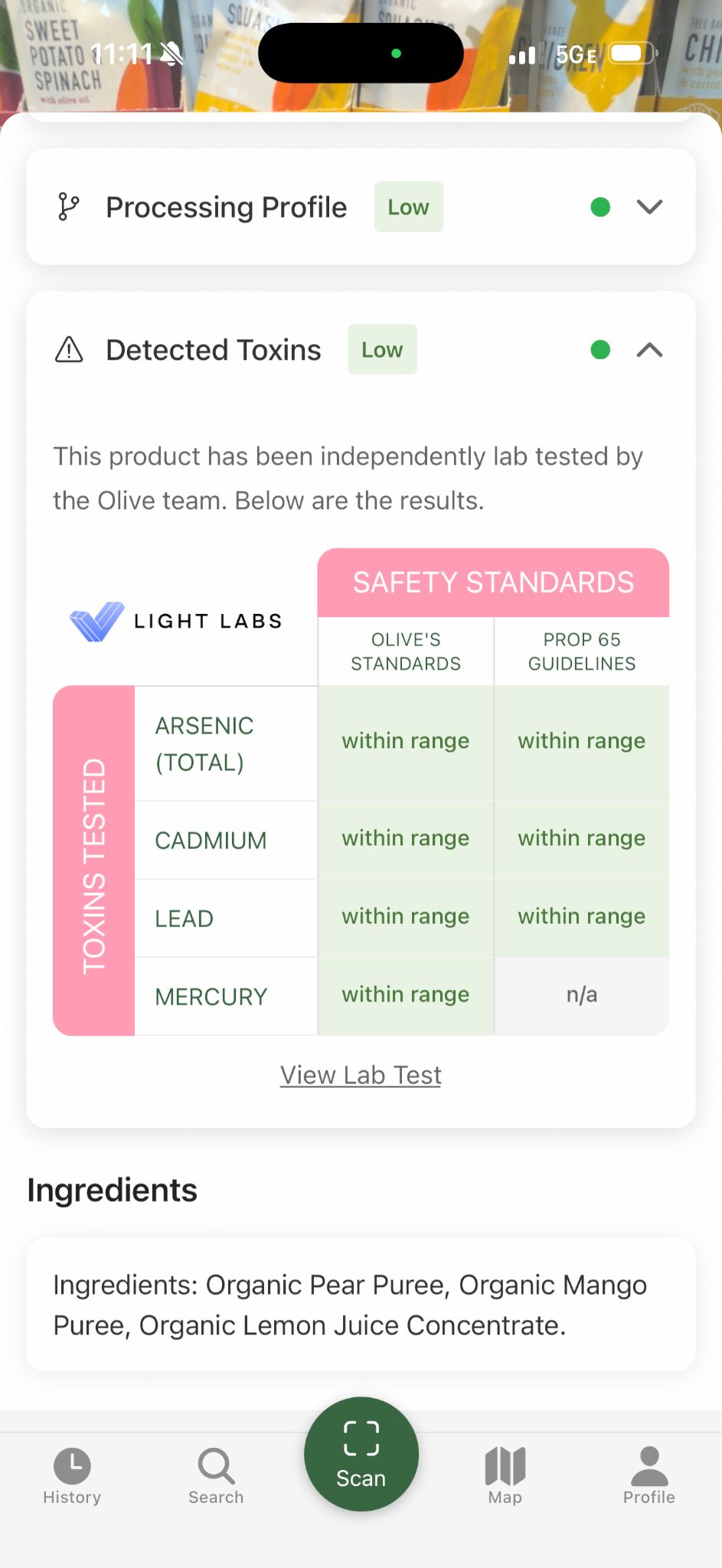
Access findings from independent laboratory testing for heavy metals such as lead, cadmium, mercury, and arsenic across approximately 400 products, exceeding the scope of Consumer Reports’ testing in this area
Personal Olive profile
Create a personal social profile where you can view your Olive score and scan history, follow other users, and connect with people on a similar clean-living path
1:1 health coaching
Receive a sustainable weight loss plan and personal guidance tailored to your goals
Peptide protocols
Access lab-tested peptide protocols, convenient prescriptions through clinicians nationwide, and doctor-supervised guidance
Olive offers full transparency into its business model, stating that paid subscriptions fund its independent laboratory testing and support app operations. There are no brand deals or paid reviews. Every result is grounded in product analysis, scientific evidence, and independent testing.
Yes. If a sunscreen product doesn’t list an expiration date, the FDA requires evidence that it remains stable for at least three years, so you shouldn’t use it more than three years after purchase.
If an expiration date is listed, discard the product once it passes as its safety and effectiveness can no longer be assured.
Do waterproof sunscreen products need to be reapplied as frequently?
No sunscreen product can be considered fully waterproof. Water-resistant products must undergo resistance tests and state the duration of effectiveness after swimming or sweating. Still, they should be reapplied at least every two hours and after swimming, heavy sweating, or towel-drying.
What are the environmental risks of sunscreen products?
Various studies on the environmental impacts of sunscreen products have shown that certain UV filters can bioaccumulate in marine organisms, including corals, algae, and other aquatic animals. That’s why choosing environmentally friendly sunscreen products is important, alongside considering their effects on human health.
I've been scanning the foods my daughter loves and I'm truly shocked at how many of them that I thought were healthy are actually really bad 😭 but I'm SO glad I know that now!! And I can feel confident because I know Olive is independent (unlike so many other apps) so the label readings are actually honest!
We never monetize through brand deals, affiliate links, or ads — so you can trust our recommendations are always aligned with our users.
Frequently Asked Questions
Olive is a holistic health companion built to help you live cleaner and feel better. Scan a barcode and Olive shows you exactly what is in your food, your personal care products, and the things you bring into your home, then points you to a clean swap that actually makes a difference.
Inside the app you also get:
Health coaching
FDA recall alerts
Prop 65-aligned baby food product lookups
Proprietary lab testing data on your favorite products
Video-assisted kitchen detox walkthroughs
Maps of healthy restaurants and farmers’ markets near you
Symptom tracking and logging
Peptide and supplement dosage tracking
You scan a product. Olive scores it from 0 to 100 (higher is cleaner), explains in plain language why it scored that way, flags the harmful stuff like seed oils, additives, hidden sugars, contaminants, and endocrine disruptors, and points you to a cleaner swap.
From there, Olive helps you actually change: a 28-day kitchen detox to start, habit building, coaching, and doctor-supervised peptide protocols.
What starts with one scan can end in more energy, a clear head, and a shopping cart you finally trust.
All three. Scan food and drinks for the 0 to 100 score, with a breakdown of toxins, additives, processing, seed oils, and sugar.
Scan skincare, makeup, sunscreen, shampoo, and other personal care products and Olive rates every ingredient green, yellow, or red with a plain-language reason for the rating.
Scan bottled water and Olive checks it for contaminants such as fluoride, heavy metals, and microplastics.
We do our own independent lab testing for heavy metals (lead, cadmium, mercury, and arsenic) across roughly 400 products so far. That is more testing than most companies do, including Consumer Reports.
Our cosmetic ingredient rating system was built with the head of a chemical toxin working group, so every ingredient carries a documented reason behind its rating.
And Olive is independent. No ads, no affiliates, and we do not take money to change scores. Your subscription is what funds the testing, so Olive answers to you. All of it runs on a database of 10M+ products.
Yes. Set your goals, your diet, and your allergies, and every score and swap adjusts to you. Keto, paleo, heart-healthy, Mediterranean, halal, kosher, gluten-free, and dairy-free are all covered.
If you react to gluten, dairy, nuts, soy, or anything else, Olive flags it before it reaches your cart.
Yes. Your privacy comes first. Olive protects your personal information with strong security protocols, and your scans, your pantry, and your health details stay yours. You can read the details in our privacy policy.
Start with the free quiz. It takes about five minutes, asks about your goals, your symptoms, and what is already in your kitchen, then hands you a personalized plan. Try Olive free.